
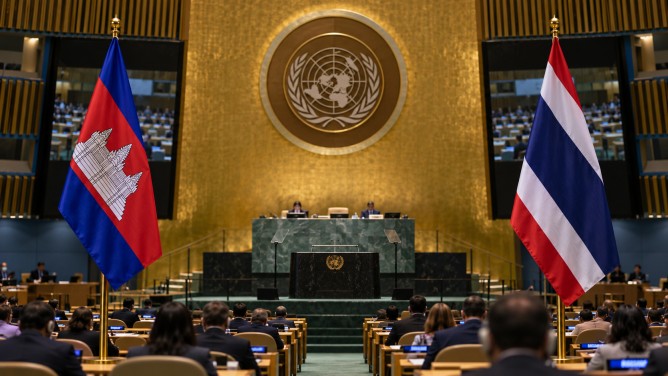
Cambodia and Thailand presented opposing views on their ongoing border dispute at the United Nations General Assembly, with both nations emphasizing the need for trust and accusing each other of insufficient efforts towards resolving the conflict. Cambodian Foreign Affairs Minister Prak Sokhonn urged Thailand to adhere to existing bilateral agreements, resume border survey and demarcation activities, and allow displaced civilians to return to their homes. Sokhonn highlighted that recent tensions have strained bilateral relations and impacted civilians and cultural heritage, emphasizing the necessity for both countries to honor previous commitments, prevent further escalation, and respect international law.
The maritime dispute between the two countries remains unresolved, with Cambodia expressing its commitment to resolving the issue through international law. Sokhonn mentioned that Cambodia had initiated compulsory conciliation proceedings under the UN Convention on the Law of the Sea following Thailand’s termination of the 2001 Memorandum of Understanding that was intended to address maritime concerns. Conversely, Thailand’s Prime Minister Anutin Charnvirakul stated that the conciliation process should focus solely on maritime boundary delimitation. Anutin called for Cambodia to engage in genuine bilateral dialogue and make efforts to rebuild trust.
Both nations emphasized the importance of cooperation, with Anutin urging enhanced collaboration on border security, demining, and combating online scam networks prevalent in the region. While a ceasefire has prevented renewed armed clashes since a 21-day confrontation last year, diplomatic tensions persist due to unresolved border disputes and related issues.
Cambodia advocates for resolving disputes through existing agreements and international law, whereas Thailand underscores the significance of bilateral dialogue and cooperation on border security. During the UN General Assembly, both countries also emphasized the importance of international cooperation and peaceful dispute resolution, underscoring the necessity for continued diplomatic engagement to address their outstanding differences.